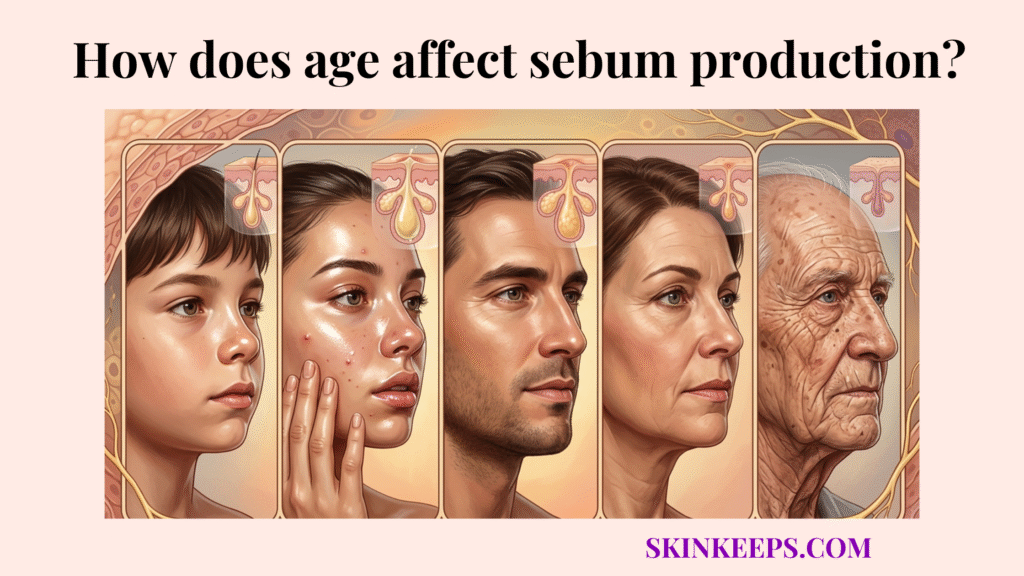
Age affects sebum production by changing the hormonal environment that regulates sebaceous glands across childhood, puberty, adulthood, menopause, and older age. This lifespan pattern explains why a routine that matched oily skin in adolescence may stop matching the same person’s skin decades later.
This guideline explains the broad lifespan pattern of sebum production, why puberty is the first major rise, why adulthood is more stable but not biologically frozen, and how perimenopause, menopause, pregnancy, and older age can alter visible oil output. It places age inside the wider biology of oily skin causes so readers can separate lifelong tendency from time-dependent change.
What is the general lifespan pattern of sebum production?
The general lifespan pattern of sebum production begins with low childhood activity, rises through puberty, becomes more stable after adolescence, and often declines later in life. Classic human data report low sebaceous secretion in children, a rise beginning in mid- to late childhood under androgen influence, and a gradual decrease after menopause in women. This biological curve is the broader age-based context behind oily skin rather than a promise that every person follows the same visible pattern. [PubMed]
One classic wax-ester study found the highest secretion rates in 15–35-year-olds and estimated adult decline of about 23% per decade in men and 32% per decade in women. These figures describe wax ester secretion across adult age, not a menopause-only drop or a universal total-sebum rule. The number is useful because it shows that adult sebaceous output can decline gradually even when the broad pattern still looks more stable than adolescence. [PubMed]
Why childhood skin usually produces less sebum
Childhood skin usually produces less sebum because sebaceous activity remains relatively low before pubertal androgen signaling becomes stronger. This pre-pubertal phase maintains a drier baseline environment across the stratum corneum. The low baseline explains why young children rarely experience heavy facial shine.
Why puberty sharply increases sebum production
Puberty sharply increases sebum production because rising androgen activity activates sebaceous glands and raises lipid output. This pubertal activation triggers the first major sustained increase in surface oil. The sudden influx of lipids often changes the complexion dramatically.
Why sebum often becomes less extreme after early adulthood
Sebum often becomes less extreme after early adulthood because the highly variable endocrine changes of adolescence give way to a more predictable adult pattern. This adult pattern usually looks less volatile than puberty, even when subtle decline starts gradually over time. The key distinction is that “more stable” does not mean “unchanged forever.”
Why sebum tends to decline in later life
Sebum tends to decline in later life because age-related endocrine change reduces the signals that sustain higher sebaceous activity. This lower-sebum stage often aligns with broad hormonal shifts like menopause, though sex differences shape the exact timeline. The resulting lower output generally makes older skin feel less greasy.
| Life Stage | Typical Sebum Pattern | Main Hormonal Context |
|---|---|---|
| Childhood | Lower output | Lower androgen influence |
| Puberty | Marked increase | Rising androgen activity |
| Early adulthood | Higher but more stable output | More established endocrine baseline |
| Midlife | Variable transition | Hormonal fluctuation becomes more relevant |
| Older age | Often lower output | Age-related endocrine decline and sex-specific patterns |
How does puberty trigger the first major increase in sebum production?
Puberty triggers the first major increase in sebum production when rising androgens activate sebaceous glands and increase their lipid output. A 2021 sebaceous-gland review notes a large rise in sebum excretion at puberty that continues until approximately age 17. This hormonal mechanism is explained in more cellular detail in oily skin sebum production, where the glandular process behind visible oil is mapped separately. [PubMed]
Teen skin often becomes oilier because more sebum reaches the follicular canal during this developmental phase. This higher surface oil can contribute to clogged pores when it combines with keratinization and acne-prone biology. The visible result varies because inherited gland sensitivity differs between individuals.
How rising androgens activate sebaceous glands at puberty
Rising androgens activate sebaceous glands at puberty by increasing hormone-driven sebocyte activity inside the follicle. This activation stimulates the glands to accumulate and release more lipids. The resulting surge in lipid output changes the formerly dry pediatric skin surface into a shinier, more lubricated barrier.
Why teen skin often becomes oilier and more acne-prone
Teen skin often becomes oilier and more acne-prone because higher sebum output can combine with follicular keratinization and congestion. This combination means that excess oil meets trapped dead cells inside the pore. The resulting congestion provides the biological foundation for adolescent breakouts.
Why puberty-related oiliness can vary widely between individuals
Puberty-related oiliness can vary widely between individuals because inherited sebaceous sensitivity changes how strongly glands respond to normal hormonal increases. This inherited tendency modifies the visible severity of the pubertal phase. The related oily skin hormones article explains the endocrine pathway in more detail.
Why does sebum production often stabilize during adulthood?
Sebum production often becomes more stable during adulthood because adolescent hormonal swings settle, although gradual age-related decline can still begin after peak young-adult years. This adult pattern usually looks less volatile than puberty, even when subtle decline starts gradually over time. The key distinction is that “more stable” does not mean “unchanged forever.”
Pregnancy can interrupt adult skin behavior in some people, but measured sebum change is not uniform enough to treat pregnancy as one fixed rule. A serial study of 10 women found only minor fluctuations during pregnancy and after pregnancy, while a later mid-pregnancy study reported lower sebum levels. This mixed evidence means pregnancy should be discussed as an individual modifier rather than a guaranteed sebum increase or decrease. [PubMed]
How hormonal patterns become more stable after puberty
Hormonal patterns become more stable after puberty because the endocrine system usually moves from rapid adolescent change into a more predictable adult rhythm. This adult predictability makes day-to-day surface lipids easier to manage with a consistent routine. The steadier rhythm reduces the sudden, intense oil spikes that characterize the teenage years.
Why some adults remain oily while others become more balanced
Some adults remain oily while others become more balanced because inherited sebaceous tendency and ongoing hormone sensitivity continue to differ between individuals. These genetic and hormonal modifiers ensure that adult skin types remain diverse. Some adults simply retain a highly active sebaceous baseline well into middle age.
How pregnancy and other hormonal shifts can interrupt adult stability
Pregnancy and other hormonal shifts can interrupt adult stability, but their effect on sebum is variable rather than uniform. These individual modifiers can cause temporary oiliness or surprising dryness depending on the person’s unique endocrine response. Therefore, expecting a universal “pregnancy glow” or “pregnancy acne” pattern oversimplifies complex biology.
How do perimenopause and menopause change sebum production?
Perimenopause and menopause can change sebum production by altering the hormonal environment that supports skin oil, hydration, and barrier function. This transition can produce mixed skin behavior because hormonal fluctuation may coexist with a longer-term trend toward lower skin oil. The result can be temporary breakouts in some people and greater dryness tendency later in the transition.
Classic human data report that sebaceous secretion in women decreases gradually after menopause, while postmenopausal sebaceous behavior remains clinically variable enough that some women report increased seborrhea. This combination supports a nuanced explanation: menopause often lowers oil output, but the transition is not visually identical for everyone. Estrogen-deficient skin is also associated with dryness, atrophy, and fine wrinkling, which helps explain why skin comfort often changes at the same time. [PubMed]
How falling estrogen changes skin comfort and oil balance
Falling estrogen can change skin comfort and oil balance by reducing support for hydration, elasticity, and barrier quality during midlife transition. This decline affects overall epidermal function alongside any direct sebaceous changes. The combined loss of estrogenic support leaves the skin feeling tighter and less resilient.
Why some people experience both hormonal breakouts and later dryness during transition
Some people experience both hormonal breakouts and later dryness during transition because perimenopause can involve fluctuation before a lower postmenopausal baseline becomes more evident. This fluctuation creates confusing periods of temporary oiliness followed by persistent dryness. Navigating this phase requires clinical caution rather than simplistic hormonal assumptions.
Why sebum decline often becomes more noticeable after menopause
Sebum decline often becomes more noticeable after menopause because the postmenopausal hormonal environment is commonly associated with lower sebaceous secretion in women. This long-term endocrine shift permanently alters the skin’s daily lipid production. As the surface oil diminishes, older users frequently notice a distinct change in their natural complexion.
| Stage or Shift | Main Hormonal Context | Common Skin Effect |
|---|---|---|
| Reproductive years | Cyclical hormone variation | Month-to-month oil variation |
| Perimenopause | Greater hormone fluctuation | Mixed oiliness, breakouts, or dryness shifts |
| Postmenopause | Lower estrogen environment | Lower sebum tendency and drier-feeling skin in many women |
Why does sebum production decline further in older age?
Sebum production often declines further in older age as endocrine signaling and sebocyte turnover change over time, although the pattern differs by sex and measurement method. Classic data found that elderly men can maintain sebum levels similar to younger adults until about age 80, while women show gradual decline after menopause. The same study also noted that surface lipid levels can fall even as sebaceous glands become larger because cellular turnover slows. [PubMed]
Lower sebum can contribute to a drier skin feel, but older age should not be described as a simple state of universally higher baseline TEWL. A systematic review found TEWL in elderly people to be generally similar or decreased compared with younger adults, and aging-barrier research emphasizes altered function and slower recovery rather than one fixed TEWL direction. This makes “drier feel with more complex barrier behavior” the safer explanation. [PubMed]
How aging changes sebaceous gland activity
Aging changes sebaceous gland activity by altering sebocyte turnover and reducing the efficiency of surface lipid output over time. This altered gland behavior means the biological machinery operates much more slowly. The slower operation yields a consistently less oily skin surface in later decades.
Why older skin often feels less oily and more fragile
Older skin often feels less oily and more fragile because lower surface lipids can occur alongside age-related changes in epidermal structure and recovery. This combined effect makes the skin barrier feel thinner and more delicate. The drier feel requires protective care rather than aggressive lipid removal.
How reduced sebum changes barrier comfort and skin feel
Reduced sebum can change barrier comfort and skin feel by lowering surface lubrication, even though baseline TEWL findings in older adults are mixed. This lower surface lubrication leaves the epidermis feeling physically tight or papery. The reduced comfort emphasizes the need for replenishing hydration to support slower barrier recovery.
What routine mistakes happen when sebum production changes with age?
Routine mistakes happen when sebum production changes with age but skincare habits remain tied to an older skin baseline. A routine that once matched adolescent oiliness may become too stripping when current output is lower. This is why continuing oily skin harsh products into lower-sebum years can make skin feel tight even if the person once tolerated them well.
Older oil-prone users may still need more hydration support because oil level and water balance are separate needs. A person can remain somewhat oily while also feeling dehydrated or less comfortable than before. The mistake is assuming past oiliness removes the need to reassess present skin comfort.
Why teenage oil-control routines can become too harsh later in life
Teenage oil-control routines can become too harsh later in life when they are continued after natural oil output has declined. This age mismatch strips the increasingly fragile barrier. Relying on youthful astringents ultimately creates unnecessary dryness and irritation.
Why older oily-skin users may still need more hydration support
Older oily-skin users may still need more hydration support because sebum level and water balance are separate aspects of skin function. Even if visible shine persists, introducing an appropriate oily skin moisturizer ensures the stratum corneum maintains comfortable hydration without heavy grease. Past shine simply does not cancel present hydration needs.
Why refusing to adjust to lower sebum can worsen tightness and irritation
Refusing to adjust to lower sebum can worsen tightness and irritation when the routine keeps removing more surface lipid than the current skin state tolerates. This friction between lower output and old habits damages the acid mantle. Accepting the changed baseline restores harmony between the skin and the daily routine.
| Mistake | Why It Happens | Likely Result |
|---|---|---|
| Keeping an aggressive teen routine | Habit from earlier oily years | Tightness, irritation, barrier stress |
| Avoiding moisturizer out of fear | Old oily-skin assumptions | Dehydrated, uncomfortable skin |
| Using very heavy products too early | Overcorrecting temporary dryness | Congestion or heaviness |
| Not re-evaluating after hormonal shifts | Routine stays fixed while biology changes | Poor skin match over time |
Which skincare priorities fit different sebum stages of life?
Skincare priorities should fit different sebum stages of life by matching care intensity to current oil output, comfort, and congestion risk. Higher-sebum years usually need more attention to congestion control, while transition years require more flexibility because oiliness and dryness can alternate. The focused guide on oily skin hormones can be reviewed because hormonal timing often determines when those shifts become noticeable.
Lower-sebum years usually benefit from gentler cleansing and stronger barrier support than earlier decades. That does not mean every person must switch to rich products immediately. The correct adjustment depends on current skin feel, visible congestion, and how much natural oil is still present.
Which priorities fit higher-sebum years
Priorities that fit higher-sebum years emphasize gentle oil regulation, congestion control, and barrier-safe use of exfoliating actives when needed. This approach targets visible shine and recurrent clogged pores with ingredients like salicylic acid. The goal is steady moderation rather than overly strict regulation.
Which priorities fit transition years
Priorities that fit transition years emphasize flexible barrier support because oiliness and dryness can fluctuate during hormonal change. This adaptability allows the routine to soothe unexpected dryness without triggering new breakouts. Adjusting the routine dynamically matches the skin’s changing temporary needs.
Which priorities fit lower-sebum years
Priorities that fit lower-sebum years emphasize gentler cleansing, hydration, and lipid support when the skin shows lower oil output or drier comfort. This stage focuses heavily on preventing unnecessary tightness. Adaptation stays tied to current signs rather than assuming richer emollients are mandatory for everyone.
| Life Stage | Sebum Status | Main Skincare Priority |
|---|---|---|
| Teens to early adulthood | Higher output | Oil regulation and congestion control |
| Adult transition years | More variable | Balance, barrier support, flexible routine |
| Menopause and older age | Often lower output | Gentle cleansing, hydration, lipid support when needed |
How should a routine adapt as sebum production changes with age?
A routine should adapt as sebum production changes with age by matching present skin behavior instead of repeating habits from an earlier life stage. Major hormonal events such as puberty, pregnancy, perimenopause, or menopause are useful moments to reassess, but the routine should change only when the skin itself shows a new pattern. The broader oily skin care tips guide clarifies how age adaptation still depends on a stable daily foundation.
Cleansing often needs to become gentler when the skin begins feeling tighter, drier, or less tolerant of old oil-control steps. Barrier support often matters more as visible oil declines or comfort worsens. The best routine is the one that matches current output, not the one that once worked best years earlier.
Why skin type should be re-evaluated after major hormonal changes
Skin type should be re-evaluated after major hormonal changes because life-stage shifts can alter the current behavior of sebaceous glands and skin comfort. This reassessment acknowledges that skin biology evolves safely and naturally. Re-evaluating ensures the products applied support the present rather than the past.
How cleansing should become gentler as sebum declines
Cleansing should become gentler as sebum declines when stronger cleansers begin causing tightness, discomfort, or unnecessary dryness. This gentler approach relies on symptom-based decisions rather than forcing cream cleansers on everyone universally. Respecting the acid mantle preserves essential hydration.
Why barrier support often matters more with age
Barrier support often matters more with age because lower surface lipids and slower recovery can make the skin less tolerant of harsh routines. This structural support helps the epidermis defend itself against environmental friction. Maintaining this comfortable boundary keeps the complexion looking healthy across all decades.
Adapting Skincare to Age-Related Sebum Change
FAQs
How does age affect sebum production?
Age affects sebum production by changing the hormonal signals that regulate sebaceous glands. Sebum is low in childhood, rises around puberty, becomes more stable after adolescence, and often declines later in life.
Why does puberty make skin oilier?
Puberty makes skin oilier because rising androgens activate sebaceous glands and increase lipid output. This is the first major sustained rise in sebum across the lifespan.
Does sebum stay the same through adulthood?
Sebum often becomes more stable after puberty, but it does not always stay unchanged. Some measures show gradual decline after peak young-adult years, and sex differences matter.
Does menopause reduce sebum?
Menopause is commonly associated with lower sebaceous secretion in women, but the transition can vary. Some people experience mixed oiliness and dryness before a lower postmenopausal baseline becomes clearer.
Does pregnancy always make skin oilier?
No. Pregnancy does not have one universal sebum pattern. Studies show mixed findings, including only minor fluctuations in one serial study and lower mid-pregnancy sebum in another.
Why does older skin feel drier?
Older skin can feel drier because surface lipids often decline and barrier recovery becomes less efficient. This does not mean baseline TEWL is always higher in every older adult.
Should skincare change with age?
Yes, skincare should be re-evaluated when current oil output, comfort, or tolerance changes. A routine should match the skin’s present behavior rather than old habits.
Can someone stay oily with age?
Yes. Age changes general trends, but individuals differ. Some people remain oil-prone into adulthood or later life because genetics, hormones, and sex-specific patterns still matter.
Conclusion
Sebum production changes with age because sebaceous glands respond to the body’s shifting endocrine environment over time. Childhood, puberty, adulthood, menopause, and older age each create different sebum conditions. The best routine is not the one that matched your past skin, but the one that matches your current output and comfort.
Healthy long-term care follows the biology of the present decade, not the habits of the last one. At SkinKeeps, we explain these physiological timelines so readers can adapt their routines confidently as their skin evolves.