
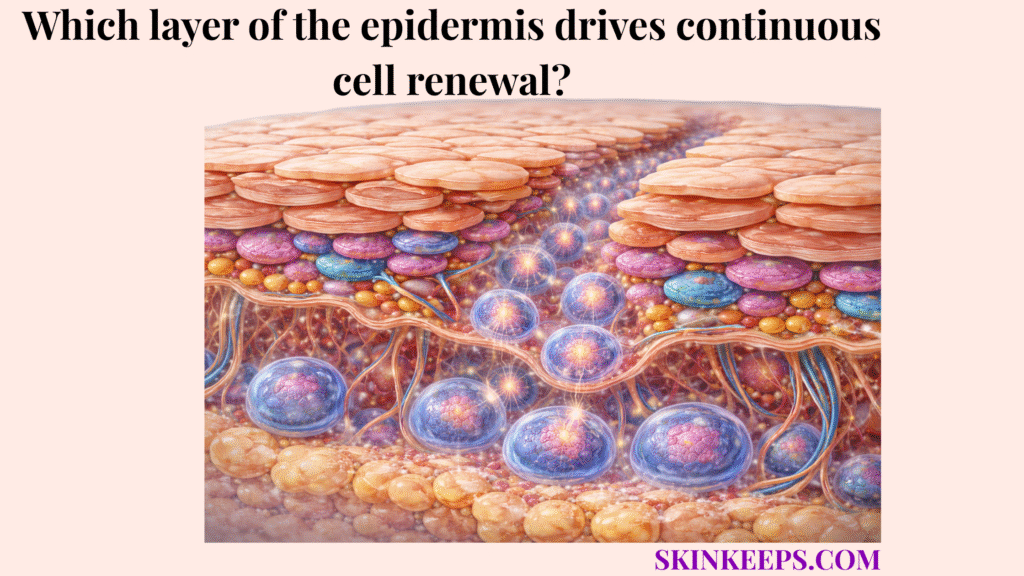
The stratum basale is the deepest layer of the epidermis and its main source of newly produced keratinocytes. Basal stem and progenitor cells divide to maintain the epidermis, while their descendants move upward, differentiate, and eventually form the protective stratum corneum.
This process continually replaces cells shed from the skin surface. Its pace and appearance vary with age, body site, health, and external exposures; dullness or roughness alone cannot measure basal-cell activity.
This guide explains basal-layer anatomy, how stem-cell populations maintain renewal, what turnover estimates mean, why aging can change the process, and which everyday habits protect the skin without overstimulating it.
Where is the stratum basale, and why does its position matter?
The stratum basale rests immediately above the basement membrane at the dermal–epidermal junction. This interface anchors the epidermis to the dermis and allows nutrients from the vascular dermis to reach the avascular epidermis by diffusion.
The lower epidermis supports proliferating keratinocytes, whereas upper layers increasingly specialize in differentiation and barrier formation. For a wider anatomical picture, compare the epidermis with the dermis and underlying hypodermis.
- Stratum corneum: outer, cornified protective cells.
- Stratum spinosum and granulosum: intermediate differentiation layers.
- Stratum basale: principal site of epidermal cell production.
Key takeaway: The basal layer is positioned for cell production and attachment; surface protection emerges through coordinated differentiation across the layers.
Why is the stratum basale the main source of epidermal renewal?
The stratum basale contains proliferative keratinocytes, including stem and progenitor populations that sustain replacement of the surface. As cells leave the proliferative compartment, they undergo differentiation rather than continuing to divide indefinitely.
This is also the focus of how basal keratinocytes contribute to epidermal cell division. A foundational review describes basal stem cells and transit-amplifying cells as important contributors to epidermal renewal. (Koster, 2009)
Key takeaway: Basal-cell proliferation supplies the epidermis with new keratinocytes; mature corneocytes do not divide.
How are new keratinocytes produced and moved toward the surface?
Renewal combines cell division in the basal compartment with upward movement and progressive differentiation. Keratinocytes modify their shape, proteins, and lipid handling as they pass toward the skin surface.
This sequence is explained further in how new epidermal cells move toward the surface. Upward displacement is not a single mechanical push: cell adhesion, local signaling, tissue architecture, and differentiation all contribute.
Key takeaway: Basal production and subsequent maturation are linked steps in one continuing process.
How do epidermal stem cells sustain long-term renewal?
A maintained stem and progenitor population allows the epidermis to replace cells over many years. Modern research describes several models of epidermal homeostasis, including balanced probabilities of cell renewal and differentiation; the process is more complex than one mandatory division pattern. (Tang et al., 2024)
Does every stem-cell division create one stem cell and one differentiating cell?
No. Asymmetric division can produce daughters with different fates, but symmetric divisions and population-level fate balancing also contribute. Evidence differs with developmental stage, anatomical site, model organism, and the population studied. The familiar one-stays/one-leaves illustration is a useful example, not a universal rule.
Why does preserving the stem-cell population matter?
Long-term renewal depends on an appropriately maintained pool of cells capable of proliferation and differentiation. This balance supports both normal surface replacement and repair after injury; it is regulated by cellular signals and the surrounding tissue environment.
- Self-renewal: maintains the capacity for future divisions.
- Differentiation: generates the cells that eventually form the protective outer layer.
Key takeaway: The epidermis is sustained by balanced stem/progenitor behavior, not by a fixed one-to-one division rule.
What does the epidermal turnover cycle actually tell us?
Epidermal turnover describes the progression from new basal-layer keratinocytes to their eventual shedding as corneocytes. One widely cited review estimates turnover in human epidermis at approximately 40–56 days, but this is an estimate rather than a universal clock. Timing can vary by body location, age, disease, and measurement method. (Koster, 2009)
Neither a rigid 28-day rule nor a prescribed “day 1 / days 2–28 / days 29–56” schedule should be treated as a clinical timeline for an individual. The diagram below intentionally illustrates phases rather than assigning exact days.
- Basal production: proliferative cells generate new keratinocytes.
- Upward differentiation: cells become increasingly specialized as they approach the surface.
- Surface residence and shedding: corneocytes protect the body before desquamation.
Key takeaway: The entire sequence matters more than any single turnover-day estimate.
Can skin appearance reveal whether basal renewal is slowing?
Dullness, roughness, flaking, and delayed recovery may accompany changes in epidermal turnover, but they are not specific tests of stratum-basale activity. Dryness, irritation, excess surface scale, photodamage, inflammatory conditions, and product reactions can produce similar signs.
- Dull or uneven-looking skin surface
- Rough or flaky texture
- Persistent dryness or reduced comfort
- Slow visible improvement following irritation
- Recurring redness, cracking, or unusual lesions that deserve assessment
If changes are persistent, painful, rapidly progressive, or involve a wound that does not heal, seek medical assessment instead of diagnosing the basal layer from appearance alone.
When is it useful to adjust a skin-care routine?
It is sensible to simplify a routine when tightness, dryness, or irritation appears, rather than trying to force faster renewal. Skin discomfort may point to barrier stress and does not necessarily require a stronger active ingredient.
What about early dryness or mild roughness?
Begin with gentle cleansing, a suitable moisturizer, and sun protection. Review whether exfoliants or fragranced products are causing irritation.
What if flaking, sensitivity, or roughness persists?
Reduce unnecessary exfoliation and consider a clinician-guided review if a basic routine does not help. Persistent scale or redness may reflect eczema, psoriasis, or another condition rather than simple slow turnover.
When should professional input come first?
Seek professional advice for persistent lesions, bleeding, painful fissures, recurrent inflammation, or delayed healing. These symptoms cannot be reliably classified as “advanced turnover slowdown” without assessment.
Key takeaway: Adjust care to symptoms and barrier tolerance, not an assumed cellular-renewal stage.
How can epidermal renewal change with aging?
Aging can affect basal-cell proliferation, differentiation, the dermal–epidermal junction, and barrier recovery. A 2022 review summarizes age-related changes and cites studies reporting a substantial decline in turnover between adulthood and older age; however, the magnitude is not identical in every person or body site. (Aging and wound healing review, 2022)
For a more detailed discussion, see how epidermal cell turnover changes with age. Cosmetic texture also reflects hydration, UV exposure, inflammation, and dermal structure—not only the basal proliferation rate.
| Skin state | Basal activity | Turnover speed | Visible appearance |
|---|---|---|---|
| Youthful skin | Generally more active | Often faster, varies by site | Often smoother; appearance varies |
| Aging or sluggish skin | Age-related changes may reduce activity | May be prolonged | May show dryness or roughness; not diagnostic |
Key takeaway: Aging may alter turnover and repair, but appearance alone does not quantify stem-cell function.
Which skin-care ingredients and habits can support healthy epidermal renewal?
The strongest general strategy is to protect skin from ultraviolet damage, avoid chronic irritation, maintain hydration, and consider targeted treatments only when there is a clear concern. Increasing turnover as fast as possible is not a health goal.
What is the evidence for topical retinoids?
Topical retinoids, including tretinoin, affect epidermal proliferation and differentiation and have evidence for particular concerns such as acne and photoaging. A systematic review of randomized trials reported improvements in several photoaging outcomes, although study designs and responses varied. (Tretinoin systematic review, 2022)
Retinoids can also cause dryness, peeling, and irritation; they are not automatically appropriate for every person. The American Academy of Dermatology recommends cautious selection and gradual introduction and advises against retinoid use during pregnancy. (AAD retinoid guidance)
How does sunscreen help?
Sun protection reduces exposure to UV radiation that contributes to photoaging and skin damage. Choose broad-spectrum, water-resistant sunscreen with SPF 30 or higher, along with shade and protective clothing, and reapply as directed when outdoors. Sunscreen reduces risk but cannot eliminate all UV damage. (AAD sunscreen guidance)
Why is barrier-friendly care still important?
Gentle cleansing and consistent moisturizing can improve dryness and make skin care easier to tolerate. Keratinization and the formation of protective surface cells depend on coordinated maturation; stronger exfoliation does not automatically mean healthier maturation.
- Concern: persistent roughness or uneven texture.
- Safer starting point: mild cleanser, moisturizer, broad-spectrum SPF, and targeted treatment only if suitable.
- Avoid: stacking multiple irritating actives or assuming that peeling proves the treatment is working.
Key takeaway: Protecting the barrier and treating a specific concern is more useful than trying to accelerate every skin cycle.
What are the key takeaways about the stratum basale?
- The stratum basale is the principal epidermal compartment for making new keratinocytes.
- Stem and progenitor cell populations support renewal through a balance of proliferation and differentiation.
- Cells move upward, mature, form corneocytes, and are shed; the timing is variable.
- Aging can change renewal, but dullness is not proof of basal-cell failure.
- Daily sun protection, gentle cleansing, moisturization, and carefully selected treatments support skin health.
The stratum basale is the starting point of normal epidermal renewal, while the quality of the protective surface depends on the entire differentiation process and surrounding conditions.
What daily steps can support healthy epidermal renewal?
- Use a gentle cleanser and avoid excessive scrubbing or over-exfoliation.
- Moisturize if skin feels dry, tight, or uncomfortable.
- Protect exposed skin with broad-spectrum SPF 30+ and other sun-protective measures.
- Consider a retinoid only if it suits your concern and health circumstances; avoid retinoids during pregnancy.
- Seek professional evaluation for persistent, unusual, or worsening skin changes.
The aim is a stable, comfortable barrier and evidence-based treatment of real concerns—not forcing faster cellular turnover or chasing a fixed number of days.
4 Responses