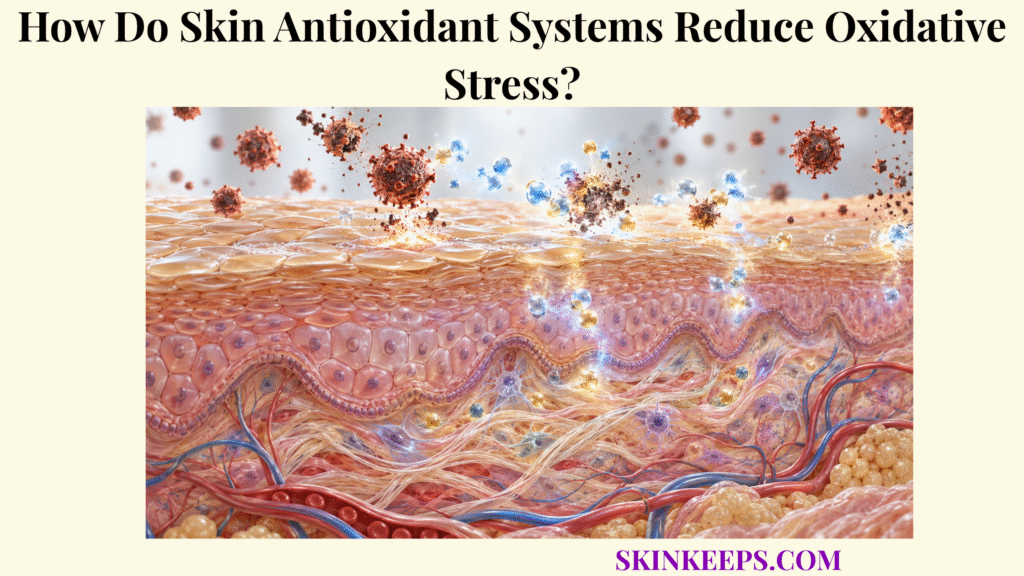
Skin antioxidant systems reduce oxidative stress by converting reactive oxygen species into more manageable products, interrupting radical chain reactions, maintaining cellular reducing capacity, and regenerating antioxidant molecules before oxidative damage spreads through skin lipids, proteins, and DNA.
Reactive oxygen species are normal parts of metabolism and signaling; oxidative stress develops when their magnitude, duration, or location exceeds redox control. Skin therefore relies on an interconnected network of enzymes, vitamin C, vitamin E, glutathione, recycling reactions, and inducible gene programs rather than one universal antioxidant.
What Triggers Skin Antioxidant Systems?
Skin antioxidant systems are continually engaged because normal metabolism produces reactive oxygen species, while ultraviolet radiation, pollutants, and inflammatory activity can increase oxidant production enough to challenge normal redox balance.
Why Does Normal Skin Metabolism Produce Reactive Oxygen Species?
Normal mitochondrial respiration, enzyme reactions, and regulated oxidase activity generate small amounts of reactive oxygen species as part of ordinary cellular metabolism and signaling. The physiological objective is controlled redox chemistry, not elimination of every ROS molecule.
How Does UV Radiation Trigger Skin Oxidative Stress?
UVA and UVB can increase reactive oxygen species through photochemical reactions, with UVA making a particularly strong contribution through endogenous photosensitization. This oxidative pathway is one part of broader skin UV defense and skin defense against solar injury; UVB can also generate ROS and should not be treated as a purely direct-DNA-damage wavelength.
How Can Pollution Trigger Skin Antioxidant Systems?
Airborne pollutants can increase oxidative load through redox-active particulate components, transition metals, quinones, PAH-related metabolism, and stress-signaling pathways. Mechanistic evidence for pollutant-induced oxidative stress and barrier disturbance is stronger than disease-specific causal epidemiology, so exposure should not be equated automatically with clinical disease.
How Does Inflammation Increase Reactive Oxygen Species?
Activated immune and stressed tissue cells can increase ROS through oxidase and mitochondrial pathways, while reactive species can feed back into inflammatory signaling when exposure persists. These oxidants also have physiological signaling and host-defense roles, and the larger cellular context belongs to skin immune defense.
When Does ROS Become Oxidative Stress?
Reactive oxygen species become oxidative stress when their magnitude, duration, localization, or persistence exceeds the capacity of antioxidant and redox systems to maintain normal molecular control.
How Do Skin Antioxidant Systems Neutralize Reactive Oxygen Species?
Skin antioxidant systems neutralize reactive oxygen species through complementary reactions that convert reactive intermediates, donate reducing equivalents, terminate oxidation chains, and restore oxidized antioxidant molecules to active forms.
Do All Skin Antioxidants Neutralize ROS the Same Way?
No. Enzymes catalytically convert selected reactive species, while low-molecular-weight antioxidants can donate reducing equivalents, quench reactive intermediates, or interrupt radical chain reactions. Superoxide, hydrogen peroxide, hydroxyl radical, singlet oxygen, and lipid peroxyl radicals differ in lifetime, location, and chemistry.
Why Does Electron Transfer Reduce Oxidative Damage?
Many antioxidant reactions stabilize reactive molecules through controlled electron or hydrogen-equivalent transfer, lowering the chance that those reactive intermediates will attack additional cellular targets. This is one redox mechanism among several and should not be reduced to every antioxidant simply “giving away an electron.”
How Do Skin Antioxidant Systems Stop Oxidation Chains?
Chain-breaking antioxidants react with propagating radicals before those radicals oxidize neighboring biomolecules. In lipid peroxidation, this interrupts a self-amplifying sequence in which one oxidized lipid can otherwise generate additional lipid radicals and reactive secondary products.
Why Must Antioxidants Be Regenerated?
Many small-molecule antioxidants become oxidized while protecting another molecule, so recycling systems must restore their reduced forms if antioxidant capacity is to continue. Glutathione and the vitamin C–vitamin E network illustrate this renewable but finite redox design.
How Do Skin Antioxidant Systems Use Enzymes for Protection?
Skin antioxidant systems use coordinated enzymes rather than a single scavenger: superoxide dismutases convert superoxide into hydrogen peroxide, while catalase, glutathione peroxidases, peroxiredoxins, and related systems control the resulting peroxides.
How Does Superoxide Dismutase Protect Skin Cells?
Superoxide dismutases rapidly convert superoxide into hydrogen peroxide and molecular oxygen, limiting superoxide accumulation while transferring the oxidant burden to downstream peroxide-control systems. SOD therefore does not convert superoxide directly into harmless water.
How Does Catalase Control Hydrogen Peroxide?
Catalase decomposes hydrogen peroxide into water and oxygen, particularly in cellular locations such as peroxisomes where peroxide handling is prominent. Its major physiological substrate is hydrogen peroxide; catalase is not a universal free-radical scavenger.
How Does Glutathione Peroxidase Control Peroxides?
Glutathione peroxidases use reduced glutathione (GSH) to reduce hydrogen peroxide and selected lipid hydroperoxides, generating oxidized glutathione (GSSG). This couples peroxide removal directly to the cellular glutathione pool.
How Is Reduced Glutathione Restored?
Glutathione reductase uses NADPH-derived reducing power to convert GSSG back to GSH, allowing glutathione-dependent peroxide control to continue. The cycle therefore depends on both antioxidant molecules and the metabolic reducing power needed to regenerate them.
What Additional Enzyme Systems Support Redox Control?
Peroxiredoxin–thioredoxin and glutathione-S-transferase systems add peroxide control, thiol-redox regulation, and detoxification across cellular compartments. These pathways expand the network beyond SOD, catalase, and GPx without replacing their specialized roles.
How Do Skin Antioxidant Systems Use Non-Enzymatic Antioxidants?
Skin antioxidant systems use non-enzymatic molecules such as vitamin C, vitamin E, glutathione, uric acid, and ubiquinol to provide reducing capacity and radical control in different aqueous and lipid-rich cellular environments.
How Does Vitamin C Protect Aqueous Skin Compartments?
Vitamin C is a water-soluble reducing antioxidant that can react with reactive intermediates in aqueous environments and participate in regeneration of other antioxidant molecules. Its location and chemistry distinguish it from lipid-phase antioxidants.
How Does Vitamin E Protect Skin Lipids?
Vitamin E, especially α-tocopherol, is a lipid-soluble chain-breaking antioxidant that intercepts lipid radicals in membranes and other lipid-rich environments, limiting propagation of lipid peroxidation.
How Do Vitamin C and Vitamin E Work Together?
After vitamin E reacts with a lipid radical, vitamin C can help reduce the resulting tocopheroxyl radical back toward active vitamin E. This links aqueous and lipid-phase redox defense and demonstrates why antioxidant molecules operate as a network rather than as independent competitors.
How Does Glutathione Support Non-Enzymatic Antioxidant Defense?
Glutathione provides intracellular thiol-reducing capacity, participates directly in redox reactions, supplies glutathione peroxidases, and supports regeneration of other antioxidant systems. It is a central intracellular reducing system, not a universal “master antioxidant.”
Are Vitamin C, Vitamin E, and Glutathione the Only Skin Antioxidants?
No. Skin also contains uric acid, ubiquinol, carotenoids, thiol compounds, and additional redox-active molecules. Their relative contribution depends on compartment, local chemistry, and oxidative demand.
| Antioxidant system | Main reactive target / context | Protective role |
|---|---|---|
| Superoxide dismutase | Superoxide O₂•⁻ | Converts superoxide to H₂O₂ |
| Catalase | Hydrogen peroxide | Converts H₂O₂ to water + oxygen |
| Glutathione peroxidase | H₂O₂ / lipid hydroperoxides | Reduces peroxides using GSH |
| Glutathione reductase | GSSG | Regenerates reduced GSH using NADPH |
| Peroxiredoxin / thioredoxin | Peroxides / protein redox | Fine peroxide and thiol-redox control |
| Glutathione | Intracellular redox | Reducing buffer + GPx substrate |
| Vitamin C | Aqueous phase | Radical reduction + vitamin E regeneration |
| Vitamin E | Lipid membranes | Terminates lipid-peroxidation chains |
| Ubiquinol | Lipid / membrane compartments | Redox and lipid-phase antioxidant function |
| NRF2 pathway | Oxidative / electrophilic stress | Increases cytoprotective gene expression |
Antioxidant systems are specialized and interdependent; one component cannot substitute for the entire redox network.
How Do Skin Antioxidant Systems Protect Lipids, Proteins & DNA?
Skin antioxidant systems protect lipids, proteins, and DNA mainly by reducing the reactive species and radical chain reactions that would otherwise chemically modify these molecules.
How Do Skin Antioxidant Systems Protect Membrane and Barrier Lipids?
Antioxidant systems reduce initiation and propagation of lipid peroxidation, helping preserve membrane organization and limiting formation of reactive lipid-derived aldehydes such as 4-hydroxynonenal (4-HNE) and malondialdehyde (MDA). These reactions protect molecular components associated with skin barrier protection but do not directly rebuild damaged lipid lamellae.
How Do Skin Antioxidant Systems Protect Proteins?
By controlling reactive species, antioxidant systems reduce oxidation of amino-acid residues, protein thiols, structural proteins, and enzyme active sites that could otherwise change protein folding, signaling, structural integrity, or catalytic activity. Protein carbonylation is one useful marker of oxidative protein damage.
How Do Skin Antioxidant Systems Protect DNA?
Antioxidant systems reduce formation of oxidative DNA lesions by lowering reactive-species exposure before bases and DNA backbones are chemically modified. A key example is 8-oxo-7,8-dihydroguanine (8-oxoG), an oxidized guanine lesion that can increase mutation opportunity if it persists into replication.
Do Skin Antioxidant Systems Repair Oxidized DNA?
No. Antioxidants reduce formation and propagation of oxidative lesions, while dedicated repair pathways such as base excision repair process lesions that have already formed. OGG1-initiated repair of 8-oxoG belongs to skin DNA repair.
How Does Molecular Protection Support Keratinocyte Function?
Reducing oxidation of membranes, enzymes, DNA, and mitochondrial components helps keratinocytes maintain signaling, metabolism, differentiation, and barrier-related functions under environmental stress. When oxidative injury rises, these redox effects intersect with the keratinocyte response to UV-induced cellular damage.
How Do Skin Antioxidant Systems Recover After Oxidative Stress?
Skin antioxidant systems recover after oxidative stress by recycling oxidized antioxidants, regenerating reducing equivalents, replenishing glutathione pools, and inducing cytoprotective genes when stress-responsive pathways such as KEAP1–NRF2 are activated.
How Is Glutathione Recycled After Oxidative Stress?
Oxidized glutathione is converted back toward reduced GSH by glutathione reductase using NADPH, restoring the pool required for glutathione-dependent peroxide control. This rapid biochemical recycling differs from slower changes in gene expression.
How Are Vitamin Antioxidants Recycled?
Antioxidant molecules can regenerate one another through coupled redox reactions, with vitamin C playing an important role in restoring oxidized vitamin E within the antioxidant network. Recovery depends on available reducing capacity and is not instantaneous or unlimited.
How Does NRF2 Increase Antioxidant Capacity?
Oxidative or electrophilic stress can alter KEAP1-dependent regulation so that NRF2 becomes more stable, accumulates in the nucleus, and regulates antioxidant-response-element genes involved in glutathione metabolism, quinone handling, peroxide defense, and broader cytoprotection. NRF2 is a redox-responsive transcription factor, not an antioxidant enzyme.
Does Recovery Mean Skin Returns Instantly to Baseline?
No. Biochemical recycling can occur relatively rapidly, while restoration of depleted antioxidant pools and stress-induced gene expression develops over different timescales according to oxidative burden and cellular resources. No universal recovery time applies to every exposure.
When Do Skin Antioxidant Systems Become Overwhelmed?
Skin antioxidant systems become overwhelmed when reactive-species production is too intense, prolonged, or repetitive for enzymatic conversion, antioxidant recycling, and redox adaptation to maintain homeostasis.
How Can Excess UV Overwhelm Skin Antioxidant Systems?
Strong or repeated UV exposure can generate reactive species faster than antioxidant enzymes and reducing molecules can control them, while simultaneously oxidizing or consuming parts of the antioxidant network. This oxidative component occurs alongside the broader skin epidermal UV response.
How Can Pollution Overwhelm Skin Antioxidant Systems?
Persistent exposure to redox-active particulate components, ozone, and pollutant-associated chemicals can add repeated oxidative load and inflammatory signaling that exceeds local buffering capacity. Mechanistic evidence supports this pathway, but not every pollution exposure produces clinical disease.
What Happens When Antioxidant Molecules Become Depleted?
Oxidation or depletion of GSH, vitamin C, vitamin E, and related reducing systems lowers immediate capacity to terminate additional oxidative reactions until recycling and replenishment restore a more favorable redox state. Depletion is therefore a dynamic limitation rather than necessarily a permanent loss.
How Does Persistent Oxidative Stress Affect Inflammation?
Persistent oxidative stress can activate or sustain redox-sensitive inflammatory pathways, while inflammation can generate additional oxidants, creating a self-reinforcing stress cycle. Normal inflammatory oxidants still have signaling and antimicrobial functions, so the relationship is not purely pathological.
How Can Persistent Oxidative Stress Affect the Skin Barrier?
Continued lipid, protein, and keratinocyte oxidation can disturb epidermal differentiation and barrier homeostasis, while an impaired barrier can increase vulnerability to additional environmental stress. This feedback is related to—but does not fully explain—skin barrier disruption.
How Does Repeated Oxidative Stress Contribute to Photoaging?
Repeated UV-driven oxidative and inflammatory signaling contributes to long-term epidermal dysfunction and dermal matrix remodeling associated with photoaging. Detailed MMP, collagen-fragmentation, and elastosis biology falls outside this redox-defense page.
What Are the Key Takeaways About Skin Antioxidant Systems?
The key fact about skin antioxidant systems is that they maintain redox balance through a coordinated network of enzymes, small-molecule antioxidants, recycling reactions, and stress-responsive gene programs rather than by eliminating every reactive oxygen species.
SOD, catalase, glutathione-dependent enzymes, vitamin C, vitamin E, glutathione, peroxiredoxin/thioredoxin systems, and KEAP1–NRF2 responses solve different redox tasks. Their combined protection reduces oxidation of lipids, proteins, DNA, and mitochondria, but capacity remains finite under intense or repeated environmental and inflammatory stress.
- Reactive oxygen species are normal products of metabolism and signaling.
- Oxidative stress develops when oxidant burden overwhelms normal redox control, not merely when ROS are present.
- UV radiation, pollution, inflammation, and metabolism can all increase oxidative load.
- UVA is a major source of photosensitized oxidative stress, but UVB can also generate ROS.
- SOD converts superoxide into hydrogen peroxide rather than directly into harmless water.
- Catalase, glutathione peroxidases, and peroxiredoxin systems control hydrogen peroxide and related peroxides.
- Glutathione peroxidase uses reduced glutathione during peroxide reduction.
- Glutathione reductase and NADPH regenerate reduced glutathione.
- Vitamin E is especially important in lipid-rich environments.
- Vitamin C operates mainly in aqueous environments and can help regenerate vitamin E.
- Glutathione is a major intracellular thiol redox buffer, not a “master antioxidant.”
- Antioxidants work as a network rather than isolated molecules.
- Lipid peroxidation can generate reactive secondary products such as 4-HNE and MDA.
- Oxidative stress can modify proteins and alter enzyme or structural function.
- Antioxidants reduce oxidative DNA lesion formation but do not repair existing DNA themselves.
- 8-oxoG is an oxidative DNA lesion handled mainly through BER initiated by OGG1.
- NRF2 is a redox-responsive transcription factor, not an antioxidant enzyme.
- KEAP1–NRF2 signaling can increase cytoprotective gene expression during stress.
- Antioxidant molecules can be recycled and regenerated.
- Strong or persistent stress can deplete or overwhelm antioxidant capacity.
- Persistent oxidative stress can amplify inflammation and barrier dysfunction.
- Skin antioxidant systems reduce oxidative injury but cannot eliminate damage from excessive or repeated environmental exposure.
What Common Questions Do People Ask About Skin Antioxidant Systems?
Common questions about skin antioxidant systems focus on whether all reactive oxygen species are harmful, how antioxidant enzymes work together, why vitamins C and E perform different jobs, whether antioxidants repair DNA, and what happens when redox defenses are overwhelmed.
Are All Reactive Oxygen Species Harmful to Skin?
No. Low and regulated levels of reactive oxygen species participate in normal cellular signaling, whereas excessive or poorly controlled oxidant production can shift cells into oxidative stress and molecular injury.
Why Do Skin Antioxidant Systems Need Both SOD and Catalase or Glutathione Peroxidase?
Superoxide dismutase converts superoxide into hydrogen peroxide, so downstream peroxide-removal enzymes such as catalase, glutathione peroxidases, and peroxiredoxins are needed to prevent hydrogen peroxide from accumulating excessively.
How Do Vitamin C and Vitamin E Work Together in Skin Antioxidant Systems?
Vitamin E interrupts radical chain reactions in lipid-rich environments, while water-soluble vitamin C can help regenerate oxidized vitamin E, linking aqueous and lipid-phase antioxidant defense.
Do Skin Antioxidant Systems Repair Oxidative DNA Damage?
Not directly. Antioxidants reduce the formation and propagation of oxidative injury, while DNA-repair pathways such as base excision repair correct selected oxidized DNA bases after lesions have formed.
Can Skin Antioxidant Systems Be Overwhelmed?
Yes. When UV, pollution, inflammation, metabolism, or other oxidant sources generate reactive species faster than antioxidant conversion, recycling, and adaptation can control them, oxidative damage can accumulate in lipids, proteins, DNA, and cellular structures.
Sources & Evidence
2. Free Radicals and Extrinsic Skin Aging
3. Impact of Airborne Particulate Matter on Skin: A Systematic Review
4. Oxidative Stress and Antioxidant Strategies in Dermatology
5. Targeting the Redox Balance in Inflammatory Skin Conditions
6. The Roles of Vitamin C in Skin Health
7. DNA Repair After Oxidative Stress: Current Challenges
8. NRF2 in Dermatological Disorders: Protection Against Cutaneous Photodamage
Medical/Educational Disclaimer
This page explains normal skin redox physiology and is not medical or supplement advice. Seek professional evaluation for severe photosensitivity, persistent inflammation, blistering, non-healing lesions, or significant tissue injury.