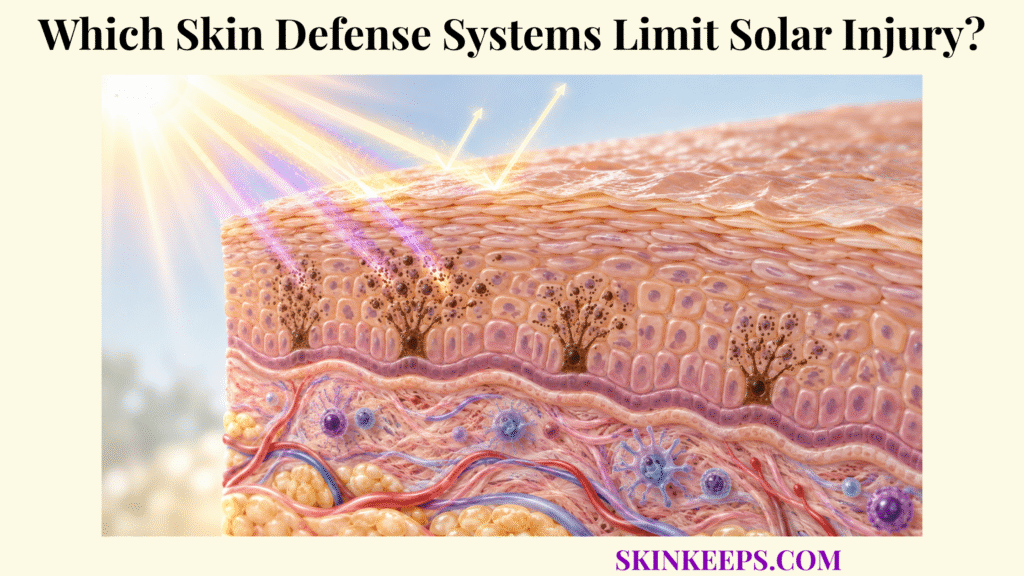
Skin defense systems limit solar injury through multiple layers: epidermal structures reduce some incoming ultraviolet radiation, melanin absorbs additional UV, antioxidants control reactive oxygen species, DNA-repair systems correct genomic lesions, and damaged-cell and immune responses contain injury that escapes earlier defenses.
No single mechanism is sufficient. Some defenses reduce exposure before living cells are injured, while others act after molecular stress begins; natural defenses reduce solar injury but cannot prevent all UV-related molecular damage.
What Skin Defense Systems First Reduce UV Exposure?
Skin defense systems first reduce UV exposure through the stratum corneum and underlying epidermis, where tissue thickness, keratinized structures, endogenous chromophores, pigmentation, absorption, and scattering decrease the amount of radiation reaching deeper living cells.
How Does the Stratum Corneum Reduce Incoming UV?
The stratum corneum attenuates part of incident UV through absorption by cornified material and endogenous chromophores plus scattering at tissue interfaces. Its detailed architecture belongs to the stratum corneum barrier page, and it should not be interpreted as a layer that blocks all UV.
How Does Viable Epidermal Tissue Add UV Attenuation?
Viable epidermal layers add optical path length and cellular material that can absorb or redirect ultraviolet radiation before it reaches basal cells and the dermis. Human evidence supports contributions from several epidermal structures, but their relative importance varies with site, pigmentation, wavelength, and study method.
How Does Skin Epidermal Thickness Change Physical UV Protection?
Greater epidermal thickness increases the distance and amount of tissue UV must traverse, which can reduce the fraction of later radiation transmitted toward deeper cells. This delayed structural adaptation is explained in more depth in skin epidermal thickening and belongs within the broader skin UV defense network.
Is Physical Attenuation Enough to Prevent Solar Injury?
No. Some UVA and UVB pass through superficial tissue, so pigmentary and cellular defense systems remain necessary after the first optical barrier. Solar injury includes molecular effects that can occur without visible sunburn.
How Do Skin Defense Systems Use Melanin Against UV?
Skin defense systems use melanin by producing pigment in melanocyte melanosomes and distributing it into keratinocytes, where it absorbs ultraviolet radiation and can concentrate near nuclei to reduce DNA-directed exposure.
How Do Melanocytes Produce UV-Protective Melanin?
Basal epidermal melanocytes synthesize eumelanin and pheomelanin inside specialized organelles called melanosomes. Pigment chemistry matters because eumelanin is generally more photoprotective, while pheomelanin provides weaker protection and has greater pro-oxidant potential under selected conditions.
Why Must Melanosomes Be Transferred to Keratinocytes?
Transfer spreads pigment through the epidermis, allowing UV-absorbing melanin to protect the numerous keratinocytes that contain most epidermal nuclei. Visible pigmentation differences reflect melanogenic activity, pigment chemistry, melanosome characteristics, transfer, distribution, and persistence rather than a simple melanocyte-number difference.
How Does Melanin Reduce UV Reaching DNA?
Melanin absorbs part of incoming UVA and UVB and can become positioned around keratinocyte nuclei, reducing the photon burden reaching genomic DNA. The detailed optical mechanism belongs to skin melanin UV absorption.
Does Melanin Provide Complete Solar Protection?
No. Melanin substantially reduces UV exposure but cannot absorb every photon, and its effectiveness varies with melanin amount, chemistry, distribution, and UV dose. Supranuclear pigment positioning adds targeted protection but does not make the nucleus optically opaque.
How Do Skin Defense Systems Limit Oxidative Stress?
Skin defense systems limit oxidative stress through coordinated enzymatic and non-enzymatic antioxidants that convert or neutralize reactive species before oxidative reactions spread through DNA, proteins, lipids, and cellular signaling networks.
How Does Solar UV Generate Oxidative Stress?
UVA and UVB can generate reactive oxygen species through photosensitization and cellular photochemistry, with UVA making a particularly strong contribution to cutaneous oxidative stress. UVB is not free of ROS-generating effects.
Which Skin Antioxidant Enzymes Control Reactive Oxygen Species?
Superoxide dismutases, catalase, glutathione peroxidases, and related enzymes convert reactive oxygen intermediates into less reactive products and preserve redox balance. These systems work with small-molecule antioxidants rather than replacing DNA repair.
How Does Glutathione Support Skin Defense Systems?
Reduced glutathione supplies reducing capacity to detoxification and peroxide-control reactions and can be regenerated through cellular redox metabolism. Detailed redox pathways belong to skin antioxidant systems.
What Happens When Antioxidant Capacity Is Exceeded?
When reactive-species production exceeds antioxidant buffering capacity, oxidative stress increases and can damage DNA, proteins, membrane lipids, and mitochondria. Antioxidants reduce oxidative injury; they do not excise CPDs.
How Do Skin Defense Systems Repair UV-Damaged DNA?
Skin defense systems repair UV-damaged DNA through lesion-specific pathways, with nucleotide excision repair removing major UV photoproducts and base excision repair handling selected oxidative DNA lesions.
How Does Nucleotide Excision Repair Correct UV Photolesions?
Nucleotide excision repair recognizes DNA distortions such as cyclobutane pyrimidine dimers (CPDs) and 6-4 photoproducts (6-4PPs), removes a short damaged DNA segment, and resynthesizes the missing sequence. Global-genome NER surveys DNA broadly, while transcription-coupled NER prioritizes lesions that obstruct active transcription. Detailed repair chemistry belongs to skin DNA repair.
How Does Base Excision Repair Correct Oxidative DNA Injury?
Base excision repair uses lesion-specific enzymes to remove selected chemically altered DNA bases created by oxidative stress, including lesions such as 8-oxoG, before the affected site is rebuilt.
Does DNA Repair Correct Every UV Lesion?
No. Repair efficiency depends on lesion type, genomic location, exposure burden, cellular state, and repair capacity, so some damage can remain unresolved or persist long enough to interfere with transcription or replication.
How Does Successful Repair Reduce Mutation Persistence?
Removing a lesion before replication reduces the chance that the damaged template will undergo inaccurate bypass or become fixed as a permanent sequence change. A DNA lesion is molecular damage; it is not automatically a mutation.
| UV-related problem | Primary skin defense | Protective result | Key limitation |
|---|---|---|---|
| Incoming UV photons | Stratum corneum / epidermal tissue | Reduces penetration | Some UV passes through |
| UV reaching keratinocytes | Melanin | Absorbs / attenuates photons | Not complete |
| ROS accumulation | Antioxidant enzymes + glutathione | Limits oxidative injury | Can be overwhelmed |
| CPDs / 6-4PPs | Nucleotide excision repair | Removes photolesions | Repair may be incomplete |
| Oxidized DNA bases | Base excision repair | Corrects selected lesions | Continued ROS can add damage |
| Damaged DNA before replication | Cell-cycle checkpoints | Slows unsafe cell division | Does not repair lesions itself |
| Severe keratinocyte damage | Apoptosis | Removes unsafe cells | Excess apoptosis contributes to injury |
| UV-induced tissue damage | Immune / inflammatory coordination | Signals, clearance, regulation | UV can also suppress immunity |
Each defense system solves a different problem; no single mechanism substitutes for the others.
How Do Skin Defense Systems Control Damaged Cells?
Skin defense systems control damaged cells by slowing cell-cycle progression when genomic injury is present and triggering apoptosis when a keratinocyte’s damage becomes incompatible with safe survival.
How Do Checkpoints Stop UV-Damaged Cells From Dividing Too Soon?
DNA-damage pathways including ATR–CHK signaling and p53–p21 control can delay cell-cycle progression while repair systems process genomic lesions. These cell-fate mechanisms are treated in more depth in the keratinocyte response to UV-induced cellular damage page.
Why Does Cell-Cycle Delay Reduce Risk?
Delaying replication reduces the chance that unresolved DNA lesions will be copied or bypassed before repair has had sufficient opportunity to operate. Checkpoints create time and control; they do not remove lesions themselves.
When Do Skin Defense Systems Use Apoptosis?
When damage is sufficiently severe, keratinocytes can activate programmed cell death rather than preserve a cell with unsafe genomic injury. UV-induced apoptotic keratinocytes are commonly called sunburn cells.
Does Apoptosis Repair UV-Damaged Cells?
No. Apoptosis removes the entire damaged cell; surviving epidermal cells later restore tissue continuity through proliferation and differentiation. UV-induced apoptosis can involve p53-dependent and p53-independent pathways.
Can Damaged Cells Escape These Controls?
Yes. Some lesions persist, some checkpoints fail, and some altered cells survive, allowing mutations and abnormal clones to accumulate during chronic exposure. This creates biological risk without implying that every surviving altered cell becomes cancerous.
How Do Skin Defense Systems Coordinate Immune Responses?
Skin defense systems coordinate immune responses through keratinocyte cytokines, antigen-presenting cells, recruited leukocytes, and regulatory pathways that balance inflammation, damaged-cell clearance, repair signaling, and UV-induced immune suppression.
How Do Keratinocytes Signal After Solar Injury?
UV-stressed keratinocytes release cytokines, chemokines, prostaglandins, and other mediators that communicate local injury to neighboring epidermal and immune cells. These mediators can coordinate response while also contributing to injury when signaling is excessive or persistent.
How Do Immune Cells Respond to UV-Damaged Tissue?
Immune and phagocytic cells can participate in inflammatory signaling, debris clearance, and resolution after UV injury. The broader immune network belongs to skin immune defense.
What Role Do Langerhans Cells Play After UV Exposure?
Langerhans cells participate in epidermal antigen surveillance, but ultraviolet exposure can alter their number, migration, antigen presentation, and regulatory function rather than simply making them more active.
Does UV Exposure Always Strengthen Immune Surveillance?
No. UV can cause acute inflammation while simultaneously producing local or systemic immunoregulatory and immunosuppressive effects, including altered antigen presentation and tolerance responses.
How Does Immune Coordination Contribute to Recovery?
Balanced immune signaling can assist removal of damaged material and resolution of inflammation, but persistent or dysregulated inflammatory responses can add oxidative stress and tissue injury. Immune surveillance is important but incomplete.
When Do Skin Defense Systems Fail to Prevent Solar Injury?
Skin defense systems fail to fully prevent solar injury when ultraviolet exposure produces molecular damage faster or more extensively than structural attenuation, pigment protection, antioxidant buffering, DNA repair, cell-control, and immune systems can contain it.
How Can Solar UV Overwhelm Melanin and Physical Defenses?
Sufficient UV intensity or duration allows residual UVA and UVB to penetrate despite epidermal thickness and pigmentation, increasing direct and oxidative cellular injury. There is no universal threshold at which all defenses fail simultaneously.
What Happens When Antioxidant Systems Are Overwhelmed?
Reactive oxygen species accumulate faster than they can be detoxified, increasing oxidation of DNA, proteins, lipids, and mitochondrial components.
What Happens When DNA Repair Is Incomplete?
Persistent lesions can remain into replication or transcription, increasing genomic stress and the opportunity for permanent mutations to become fixed. Repair failure increases opportunity for mutation; it does not make mutation inevitable.
How Does Repeated Solar Injury Contribute to Photoaging?
Repeated oxidative, inflammatory, genomic, and signaling stress contributes over time to epidermal dysfunction and dermal matrix remodeling associated with photoaging, without requiring this page to expand into collagen or MMP biology.
How Can Persistent Damage Increase Abnormal Cell-Growth Risk?
Cells that accumulate relevant mutations and escape checkpoint, apoptotic, or immune control can undergo clonal expansion, creating a biological pathway toward precancerous or malignant change. This does not predict an individual’s cancer probability.
Can Solar Injury Occur Without Sunburn?
Yes. DNA photolesions and oxidative stress can occur without obvious erythema, so visible sunburn is not required for meaningful molecular injury. Natural defense systems are finite and do not make deliberate UV exposure safe.
What Are the Key Takeaways About Skin Defense Systems?
The key fact about skin defense systems is that photoprotection depends on several complementary layers: physical attenuation and melanin reduce exposure, antioxidants limit oxidative injury, DNA repair restores damaged molecules, checkpoints and apoptosis control damaged cells, and immune systems coordinate the tissue response.
These systems act before, during, and after molecular injury, but none provides complete protection. Their combined effect is best understood as damage reduction and containment rather than total exclusion of solar UV injury.
- Skin defense systems work at different stages of solar exposure.
- The stratum corneum and viable epidermis reduce part of incoming UV through absorption, scattering, and path length.
- Adaptive epidermal thickening can increase physical attenuation, but it follows prior UV stress.
- Melanin absorbs UV and reduces radiation reaching nuclear DNA; pigment type and distribution matter.
- UVA and UVB can generate reactive oxygen species.
- SOD, catalase, glutathione, and glutathione peroxidase contribute to endogenous antioxidant defense.
- Antioxidants limit oxidation; they do not repair CPDs.
- NER repairs major UV photoproducts such as CPDs and 6-4PPs.
- BER repairs selected oxidative DNA lesions.
- DNA repair can be incomplete, and a DNA lesion is not automatically a mutation.
- Cell-cycle checkpoints delay proliferation when DNA is damaged but do not remove lesions.
- Apoptosis removes severely damaged keratinocytes rather than repairing them.
- Keratinocytes coordinate inflammatory and immune signaling after UV injury.
- UV can produce both inflammation and immunosuppression.
- Langerhans-cell function can be altered by UV exposure.
- Natural skin defenses are complementary but finite.
- Persistent solar injury can contribute to photoaging, mutation accumulation, and abnormal clonal growth.
- Absence of visible sunburn does not mean absence of molecular UV damage.
- Endogenous defenses do not make deliberate or excessive UV exposure safe.
What Common Questions Do People Ask About Skin Defense Systems?
Common questions about skin defense systems focus on which defense acts first, whether melanin is enough, how antioxidants differ from DNA repair, why damaged cells stop dividing or die, and whether immune responses prevent all solar injury.
Which Skin Defense System Acts First Against Solar UV?
The stratum corneum and epidermal tissue are the first biological structures encountered by incoming UV, reducing part of the radiation through absorption and scattering before pigmentary and cellular defense systems handle the radiation or damage that remains.
Is Melanin the Most Important Skin Defense Against UV?
Melanin is a major endogenous photoprotective system, but overall defense also depends on epidermal structure, antioxidant capacity, DNA repair, cell-cycle control, apoptosis, and immune regulation, and their relative contributions vary with wavelength, skin biology, and exposure.
Do Skin Antioxidants Repair UV-Damaged DNA?
No. Antioxidants limit reactive oxygen species and oxidative injury, while dedicated repair pathways such as nucleotide excision repair and base excision repair correct specific forms of DNA damage.
Why Do Skin Defense Systems Remove Some UV-Damaged Cells?
When genomic or cellular injury becomes too severe for safe continued survival, apoptosis can remove the affected keratinocyte and reduce the chance that extensively damaged DNA will be propagated through later cell division.
Can Natural Skin Defense Systems Completely Prevent Solar Injury?
No. Physical barriers, melanin, antioxidants, DNA repair, checkpoints, apoptosis, and immune responses substantially reduce injury, but sufficiently intense or cumulative UV exposure can still produce DNA damage, oxidative stress, photoaging, and mutation risk.
Sources & Evidence
2. Pigment-independent cAMP-mediated epidermal thickening protects against cutaneous UV injury
3. The Protective Role of Melanin Against UV Damage in Human Skin
5. Transcriptional and Posttranslational Regulation of Nucleotide Excision Repair
6. Molecular Mechanisms of UV-Induced Apoptosis and Its Effects on Skin Residential Cells
7. Ultraviolet light induced injury: Immunological and inflammatory effects
8. American Academy of Dermatology — sun protection guidance
Medical/Educational Disclaimer
This page explains normal solar-defense biology and is not medical advice. Seek medical care for severe burns, unusual photosensitivity, or persistent or changing skin lesions. Natural defenses reduce UV injury but do not make intentional exposure safe.